Best DIY Power Tools 2026: Complete Buying Guide for European Home Improvers
Best DIY Power Tools 2026: Complete Buying Guide for European Home Improvers
If you're looking for the best DIY power tools in 2026, you're investing in the ability to tackle home improvement projects with confidence, precision, and efficiency. The European DIY market has never been better equipped — cordless technology has matured to the point where battery-powered tools match or exceed corded performance for most home tasks, and EU safety standards ensure that every tool sold through a legitimate retailer meets rigorous quality benchmarks. Whether you're a weekend DIYer tackling your first project or an experienced home improver building a serious toolkit, this guide covers everything you need.
EU Safety Standards for Power Tools: What Every Buyer Should Know
All power tools sold in Europe must comply with EU safety directives before they reach the market. Understanding these standards helps you buy with confidence and avoid substandard imports.
CE marking
Mandatory for all power tools sold in the EU. CE marking confirms compliance with the EU's Machinery Directive (2006/42/EC), which sets essential health and safety requirements for machinery and power tools. It also confirms compliance with the Low Voltage Directive and EMC Directive for electrical safety and electromagnetic compatibility. Never purchase a power tool without CE marking — it's a legal requirement, not a quality indicator alone.
EU Machinery Directive (2006/42/EC)
This directive requires manufacturers to conduct a risk assessment for every tool, provide comprehensive safety instructions in the language of the country of sale, and include all necessary guards and safety devices. For EU buyers, this means every CE-marked tool comes with instructions in your local language and the safety features required by law.
Noise and vibration limits
The EU's Physical Agents (Noise) Directive and Physical Agents (Vibration) Directive set exposure limits for professional use. For home DIYers, these limits are less directly relevant, but they drive manufacturers to produce quieter, lower-vibration tools — a genuine benefit for home workshop use and neighbourly relations.
Voltage compatibility
All power tools sold through EU retailers are designed for 220–240V / 50Hz, the European standard. Avoid importing tools from the US (110–120V) without a voltage converter — running a 110V tool on 240V will destroy it instantly.
The Essential DIY Power Tool Kit: What to Buy First
Building a toolkit from scratch can feel overwhelming. Here's a prioritised list of the tools that deliver the most value for home improvement projects, in order of versatility and frequency of use:
1. Cordless drill/driver
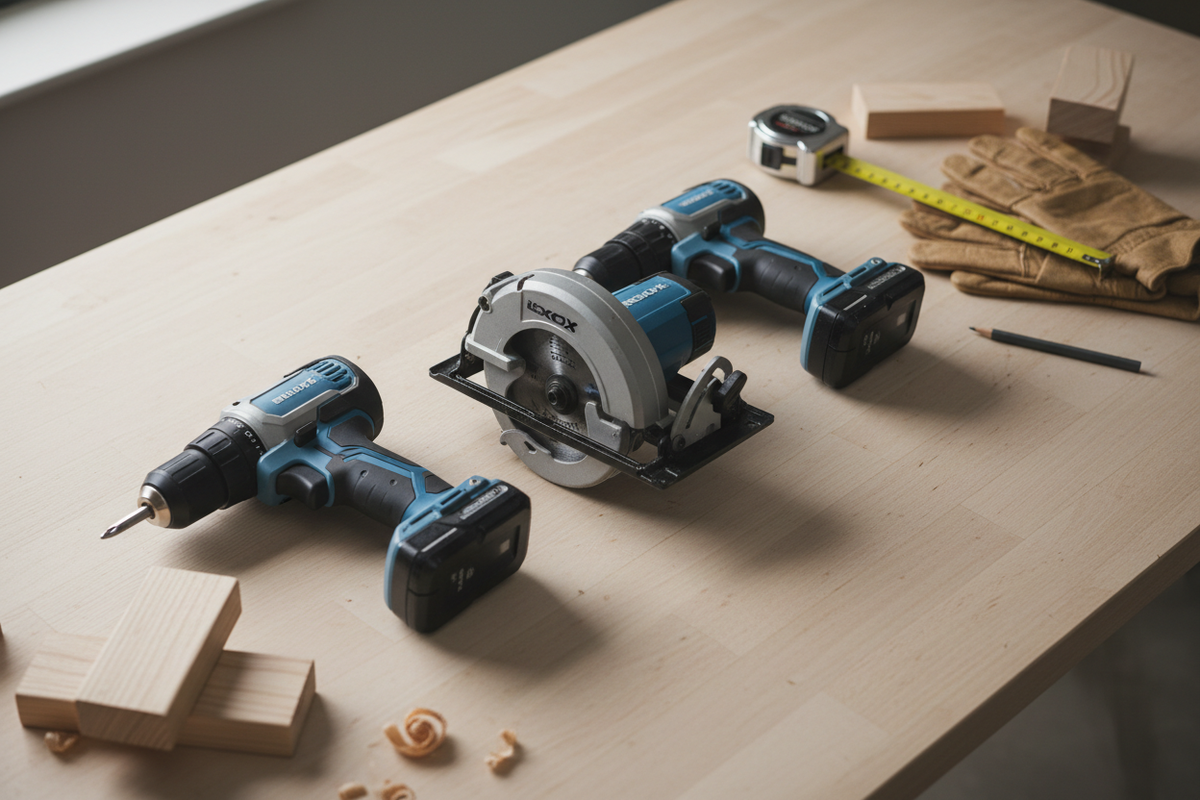
The single most useful power tool for any home. A quality cordless drill/driver handles drilling holes in wood, metal, and masonry (with the right bits), and drives screws with precision. Look for an 18V model with brushless motor technology — brushless motors are more efficient, run cooler, and last significantly longer than brushed motors. Key specs: torque of 60+ Nm for general use, variable speed trigger, and a clutch with at least 20 settings to prevent overdriving screws.
2. Cordless impact driver
Often confused with a drill/driver, an impact driver uses rotational impacts to drive screws and bolts with far greater torque than a standard drill. Essential for decking, structural work, and any application involving long or large screws. Pairs perfectly with a drill/driver — use the drill for holes, the impact driver for fasteners.
3. Circular saw or jigsaw
For cutting timber, sheet materials, and panels. A circular saw makes fast, straight cuts in large sheets; a jigsaw excels at curves, cutouts, and more intricate shapes. For most home DIYers, a jigsaw is the more versatile starting point. Look for variable speed, orbital action (for faster cutting in wood), and a dust blower to keep the cut line visible.
4. Random orbital sander
Essential for surface preparation before painting or finishing. A random orbital sander removes material faster than a sheet sander and leaves a finer finish than a belt sander. Look for variable speed, a dust collection bag or vacuum port, and hook-and-loop (Velcro) pad attachment for quick sandpaper changes.
5. Cordless multi-tool (oscillating tool)
The most versatile tool in any kit. An oscillating multi-tool with the right accessories can cut, sand, scrape, grout, and plunge-cut in tight spaces where no other tool fits. Invaluable for renovation work, undercutting door frames, removing grout, and cutting flush to surfaces.
6. Cordless angle grinder
For cutting metal, grinding welds, and removing rust. Less essential for pure woodworking projects, but indispensable for metalwork, tile cutting (with a diamond blade), and heavy material removal. Handle with care — angle grinders are the power tool most associated with workshop injuries; always use the guard and appropriate PPE.
Cordless vs. Corded: The 2026 Verdict
The cordless vs. corded debate is largely settled in 2026. For home DIY use, cordless tools win on almost every metric:
- Freedom of movement — no cable management, no extension leads, no trip hazards
- Performance parity — 18V and 36V brushless cordless tools now match corded performance for all but the most demanding sustained-use applications
- Battery ecosystem — the key advantage of committing to a single brand's battery platform: one battery works across all tools in the range, reducing cost and complexity
The main advantage of corded tools remains in sustained heavy-duty use — running a circular saw for hours of continuous cutting, for example, where battery capacity becomes a limiting factor. For occasional home DIY, this is rarely relevant.
Battery platform strategy
This is the most important purchasing decision for cordless tools. Choose a brand with a comprehensive 18V (or 20V max, which is the same thing) battery platform and commit to it. Mixing brands means multiple chargers, multiple battery types, and no cross-compatibility. The major EU-market platforms — from brands like Bosch, Makita, DeWalt, Milwaukee, and Metabo — all offer extensive tool ranges on a single battery system.
Smart Home Integration: Tools Meet Technology
The intersection of DIY tools and smart home technology is one of the most exciting developments for home improvers in 2026. Once your renovation projects are complete, the smart home ecosystem you install is what makes the finished space truly modern.
If you're renovating with smart home integration in mind, our smart home devices guide for 2026 covers everything from smart lighting and heating to security systems. And for securing the home you've worked hard to improve, our best smart locks guide for 2026 covers the top EU-compatible options in detail.
For those whose projects extend beyond the home into the garden or outdoor spaces, our best outdoor tech gadgets guide covers tools and technology for outdoor projects and adventures.
Buying Tips: How to Build Your DIY Power Tool Kit
Before purchasing, work through this checklist:
- Start with a drill/driver — it's the most versatile tool and the right starting point for any kit
- Choose a battery platform and stick to it — cross-compatibility within a brand saves money and simplifies your kit long-term
- Prioritise brushless motors — more efficient, longer-lasting, and worth the modest price premium over brushed models
- Check CE marking — mandatory for all EU-sold power tools; non-CE tools are illegal to sell in Europe and may be unsafe
- Verify voltage — all EU tools are 220–240V; avoid non-EU imports without checking compatibility
- Consider kits over individual tools — starter kits (drill + impact driver + batteries + charger) offer significantly better value than buying tools separately
- Invest in quality bits and blades — a quality drill is only as good as its bits; cheap drill bits blunt quickly and produce poor results
- Don't forget PPE — safety glasses, hearing protection, and dust masks are essential; EU-standard PPE carries CE marking
- Check the warranty — EU consumer law guarantees 2 years minimum; professional-grade brands often offer 3–5 years on tools registered online
Conclusion: Build Better in 2026
The best DIY power tools in 2026 combine cordless freedom, brushless efficiency, and EU-certified safety into a toolkit that empowers you to tackle any home improvement project with confidence. Whether you're hanging shelves, building furniture, renovating a bathroom, or transforming your outdoor space, the right tools make the difference between a frustrating experience and a satisfying result.
Browse our full range of DIY power tools at OnlineStore24.eu — with fast delivery across Europe, CE-certified products, and detailed specifications to help you build the perfect toolkit for your home and budget. Your best DIY projects are ahead of you.